
What the reserves offer for now is improved import coverage of about 13 months, almost double the 2013 level of less than seven months. And, ammunition to arrest a rapid rupee slide, says Anup Roy.

US India Business Council has urged New Delhi and America to take steps to strengthen bilateral trade relationship to realise their 'true business potential'.

'France's challenges revolve around an uncertain economic future, multiple terrorist attacks on French soil and a European migration crisis tied to the situation in Syria and Iraq.'

US companies are 'positively looking' at India.
'The economy needs to deliver the expected 7.5% growth for the markets to deliver better than single digit returns.' 'Any disappointment in growth can see the markets correcting downwards.'

The Chinese leader will display his grip on the Communist party and chart his plans for his country's future.

At the summit, the US is able to play the role of a bully.

How will the Modi Sarkar's likely return affect other nations?

In a few years from now, India will be looking at an entirely different type of military adversary across the borders, in our waters, in the air, in space and in our communication networks, says Nitin Pai.
The government told the apex court that the decision whether or not to allow refugees to settle in the country was best left to the Executive.
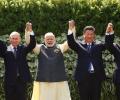
Narendra Modi's success at the BRICS summit is the best Diwali gift for India's diplomacy and marks her ascendancy to global leadership, says Tarun Vijay.

'IAF is expanding at a rapid pace'
The Prime Minister tends to keep such decisions close to his chest.

'The path to a resolution of the ethnic conflict is likely to be complicated and controversial with the majority Sinhalese community, and will become less likely if delayed.' 'It will certainly give Rajapaksa fresh political oxygen with which to revive himself and rally the opposition.'

'This novel format of diplomacy -- the informal summit -- will not only facilitate bilateral communication and reduce miscalculations at the very top level of the two governments, but possibly open the space for China and India to speak in one voice on various issues of mutual concern,' note Feng Renjie and Ding Kun Lei

One thing Beijing must understand is that India is not obsessed with being a threat to China but only wants a rightful place for itself in the world, says Sanjeev Nayyar.

The summit at Sentosa -- the first between the two countries -- is a turnaround of relations between the US president, 71, and the North Korean leader, 34, after a long-running exchange of threats and insults.

China's intended role for AIIB is not so different from the existing Western lenders like the World Bank.

His view will be shaped by his perception of US world interests and India's economic performance relative to China.

India is affected by a 'resource inefficiency curse'.

He added that the risks can increase if the Chinese slowdown gathers more speed.
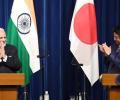
'Relations between India and Japan are robust and devoid of either shadow of history or any irritant.' 'In fact, there is plenty of warmth and goodwill earned over history. There are no negatives but only opportunities,' notes Dr Rajaram Panda.

In his fifth address as President, Pranab Mukherjee asked authorities and institutions of the State to adhere to the 'dignity' in discharging their duties.

'His popularity is still high; respect for his intellect and integrity is still discernible; but his long night may just be beginning,' says Ambassador B S Prakash.
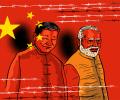
'An opportunity is at hand to think big and recast the India-China relationship on a new template, which would help the pursuit of our country's dream of major power status,' says Ambassador M K Bhadrakumar.
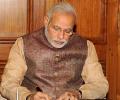
'You cannot judge a government within a month. Give us five years' time.' 'At times, strict economic decisions have to be made for the good of the poor in the long run.' Dharmendra Pradhan, one of the Modi government's stars, speaks exclusively to Sheela Bhatt/Rediff.com about why the government is forced to roll out 'bitter medicine.'

IMF attributes the slower growth rate to supply-side bottlenecks.

Barred from international competition, Russia is training its athletes at a series of special domestic tournaments and banking on hopes a doping ban will be lifted in time for this year's Rio Olympics.
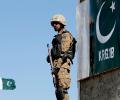
'If push comes to shove, Pakistan does have the capability to make it difficult for the US and NATO forces to make even a withdrawal of troops out of Afghanistan in orderly fashion,' says Ambassador M K Bhadrakumar.

Colombo's enduring interests suggest the relationship between the Sri Lanka and China will only strengthen, says Nitin Pai.

Several American lawmakers have slammed India for failing to condemn Russia's aggression in Ukraine, Russian rebels' downing of flight MH17 and the annexation of Crimea. The leaders also raised the issue of repeated abuse and violence against minorities and women in India. Aziz Haniffa reports.

'If we play our cards right, we may even benefit from the competition between the US and China as seen from increased investment from each of these countries into India.' 'The size of our market gives us an important lever of power which we shall have to play adroitly and intelligently,' points out Ambassador Gautam Bambawale -- who served as India's envoy to China -- in the Professor V M Dandekar Memorial Lecture 2019, delivered on March 8, 2019 in Pune.

The sector faces many challenges and calls for prompt corrective action.

According to a new report published by Switzerland-based BIS, which is also referred as 'bank for central banks', the US Federal Reserve's announcement of a possible phasing out of easy money regime has resulted in 'abrupt and sizeable' equity market losses in both advanced and emerging markets.

'The danger today is that out of sheer fatigue and exasperation, the US might cut loose and exit from Afghanistan leaving it to the region to cope with the debris, which it is ill-equipped to handle,' says Ambassador M K Bhadrakumar.

Some feel that Tata Steel has put these assets on the block only after exhausting all the options.

''There is the perennial worry in the Indian mind regarding the US 'hyphenating' India and Pakistan. Frankly, this is a completely nonsensical hypothesis. The US has always 'hyphenated' India and Pakistan and it couldn't have been otherwise,' says Ambassador M K Bhadrakumar.
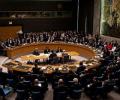
India is expected to press for text-based negotiation during the current session of the United Nation General Assembly. Suman Guha Mozumder reports from New York
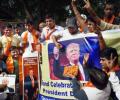
'India can rely on him to fight terrorism in all its forms, including Pakistan-sponsored outfits.'

'Clearly, from the Indian viewpoint, the US retrenchment from Asia cannot be happening as good news.' 'The abandonment of the US' pivot to Asia exposes the US-Indian partnership to be a mere transactional relationship,' says Ambassador M K Bhadrakumar
